Background
The oldest human remains in the Aljustrel area date back to the Paleolithic, when it was used as a transit point by hunter-gatherer communities. However, the establishment of a permanent population only began at the end of the third millennium BC, during the Chalcolithic period,
The medieval castle

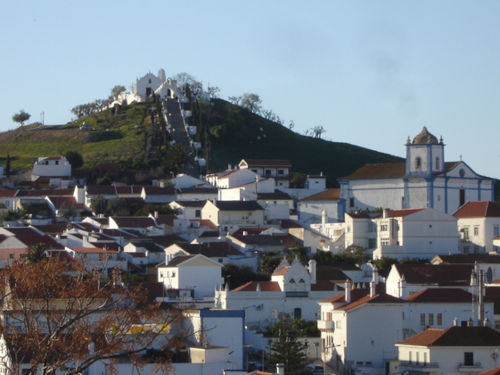
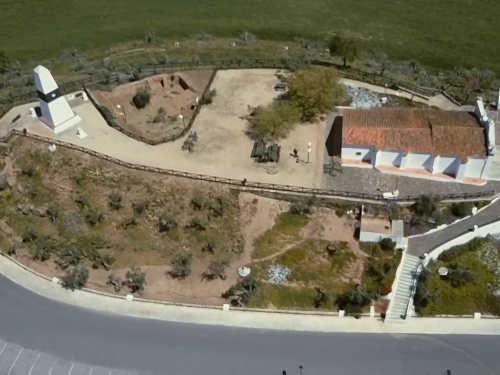
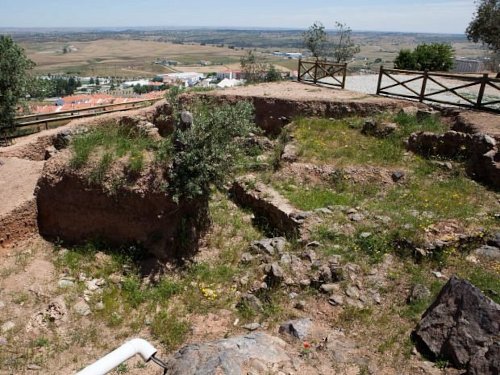
The archaeological site is located on top of a hill with a roughly oval shape, approximately 100 m long by 30 m wide, which offered good natural defense conditions, dominating the village of Aljustrel. The remains of the old castle are mainly composed of the bases of two quadrangular towers, and part of a wall made of rammed earth, enclosing a platform measuring approximately 3,000 m². Evidence of residential buildings and a circular fireplace with a small stone structure, which still had some remains of charcoal, were also found.
Next to the ruins of the old fortress is the Sanctuary of Our Lady of the Castle. The church itself is decorated with 17th century tiles, and originally had mural paintings on the nave roof, but these have been almost completely hidden by several layers of limewash. The Sanctuary is considered one of the main monuments in Aljustrel, and is part of the town's tourist route, which also includes the old mining facilities and other points of interest.
The remains found at the site include a millstone, a lunula, a ceramic spoon, various glazes from the Islamic period and later, bone fragments, as well as several lithic pieces, such as flint blades, quartz flakes, and a fragment of a polished stone adze. Among the collection from the Islamic period, the most expressive group refers to the Almohad Caliphate.
After the end of Roman civilization, the town only regained its significance in the 9th century, after the Islamic conquest, receiving the name Albasturil. According to archaeological records, the hill would have been inhabited from that time onwards, while historical documents point to the resumption of mining explorations during the Caliphal period. However, the castle itself was only built in the 11th century or in the second half of the 12th century, during a phase of development of the defences of the Al-Andalus region, in the face of pressure from the Christian reconquest.
The town was taken in 1234, during the reign of Sancho II of Portugal, by knights of the Military Sancho II of Portugal donated it to the Order of Santiago da Espada. Occupation in the castle area extended until the end of the medieval period, during the 15th century. However, in the 14th century the Chapel of Our Lady of the Castle was built, which was altered several times throughout its history.
18th and 19th centuries
In the magazine O Occidente of July 20, 1914, the journalist Henriques Marques Junior copied a description of the sanctuary and the ruins of the castle, made by Frei Agostinho de Santa Maria:
«... at the highest point of this Town you can see the Sanctuary of Our Lady of the Castle, where all those residents seek a miraculous Image of the Mother of God, which everyone considers to be Angelic, because it appeared in that same place of its Castle, which at some time would be stronger than it currently appears, since only weak ruins can be seen. This place is very high and there were large boulders there, made of a hard and strong stone that they call muar because of its great hardness; on one of these rocks, there is a common and constant tradition that the Image of Our Lady of the Castle (title taken from the place of manifestation) appeared and as she worked many wonders there, her house was built there, which is quite a Hermitage, with its main chapel and everything was arranged so that the rock that served as her throne was inside the Church where we see it outside the main chapel, placed in the creek, which divides the body of the Church from the chapel. This rock is very hard, but even so, devotees rub it to extract some powders from it, which, when applied to various complaints, especially headaches, experience shows to be a great remedy for getting rid of them. The Lady can be seen placed in a niche of glass panes, in the middle of the altarpiece, which is ancient, and is locked inside, but as the panes are large, the Lady can be seen perfectly; It is made of rock, but of such great beauty that we must believe that its artisans came from heaven... I had a particular pleasure in seeing that Lady, because she seems to be filling with joy and consolation all who visit her... Since that Most Holy Image is so venerated, there was no lack of a sacrilegious hand, which blinded by ambition (in order to steal it) broke the window and took some rich earrings that she had in her ears, which had been offered to her by a devout maiden from that land, and also took a gold cross from her beads and I don't know if also the ends.».
The Chapel was badly damaged by the Earthquake of 1755, having been subsequently rebuilt.
In issue 16 of the work Archivo Historico de Portugal, published in November 1889, the castle was already completely ruined, with the author, José Garcia de Lima, putting forward the theory that the The origin of the castle would be pre-Roman, due to its rudimentary appearance, which he considered inferior to Roman and Islamic constructions.
20th and 21st centuries
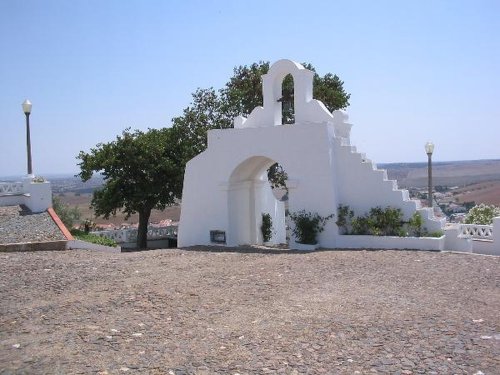
The complex of Aljustrel Castle and the Church of Our Lady of the Castle was classified as a Property of Public Interest by Decree No. 26-A/92 of 1 June.
Between 1989 and 1998, the site was the subject of several archaeological surveys and excavations, under the programme for the Study and Enhancement of Aljustrel Castle. Work began with a survey in 1989, during which the surrounding area was cleared to try to find the ancient castle walls, and remains from the Chalcolithic and medieval periods, both Islamic and Christian, were discovered, with an interruption during the Iron Age and Roman times. In 1992, emergency excavations were carried out, due to the start of works to landscape the hill of Nossa Senhora do Castelo, and it was determined that the site was occupied until the 15th century. Studies continued the following year, with various Islamic remains collected, such as common pottery and building materials.
In 1994 the excavation area was expanded, as a way of better understanding both the structures and the occupation of the castle, leading to the discovery of several residential structures, which originally had rammed earth walls. Work continued into 1995 and then took a hiatus until 1998, when the stratigraphy investigated in previous years was confirmed, with a layer of prehistoric ceramics followed by others from the medieval period. Also in that year, the castle was the target of a relocation, identification and inspection of sites by the Castro Verde division of the Portuguese Institute of Archaeology, where the state of conservation of the archaeological site was classified as regular.
The excavations were resumed between 2007 and 2010, within the scope of the National Plan of Archaeological Works, having begun with an attempt to study the various occupation stratigraphies, and their relationship with the mining industry of Aljustrel.
In 2008, the area to be studied was expanded, in order to try to understand the organization of the interior spaces, with several divisions being identified, including a possible kitchen, several streets and a sewage channel.
In 2009, the study of the organization of the internal structures of the castle was continued, with part of the rammed earth wall being identified to the north, on a Chalcolithic level. The investigations have made it possible to divide the construction of the castle into three distinct phases, two of which date back to the Almohad period and the last at the end of the medieval period, after the reconquest, although this conclusion is not certainly confirmed by the materials found.The main structure of the Christian medieval period would have been the keep, which probably served as a residence and court space for the friars of the Order of Santiago, during the final phase of the castle, when it would have already been in a process of ruin. Excavations inside the castle continued in 2010, and another layer of the Chalcolithic level was found.
Events of the time
1119 - The Pope definitively assigns the dioceses of Coimbra and Viseu to
Braga.
1121 - Alfonso II of
Aragon enters Portugal, on a sovereign mission, in the retinue of his mother, D.
Urraca.
-The expulsion of representatives from the most powerful noble
families of the County of Portucalense from the court of D. Teresa., namely the Lords of Sousa,
the Lords of Ribadouro, the Lords of Maia and also Sancho Nunes de Barbosa,
a nobleman of Galician origin, all favored by Count D. Henrique with positions of the greatest
trust.
b- Invasion and sacking of Portugal by the troops of D. Urraca, queen
of the Kingdom of León and the Kingdom of Castile
and Diego Gelmírez, archbishop of Compostela. This fact was a great humiliation for D.
Teresa, who had to retreat and take refuge in the Castle of Lanhoso,
where she ended up submitting to her sister. D. Magpie.
1122 - Afonso I of Portugal,
still an infant, becomes a knight in the Cathedral of Samora.
- Marriage of Urraca Henriques, daughter of Count D.
Henrique
and D. Teresa,
with Bermudo
Peres de Trava, member of the powerful noble Trava family of Galicia.
- The Astorga Charter was written.
1123 - Viseu - counts D. Teresa and D. Henrique who, in 1123,
granted it a charter.
1126 - Alfonso VII of Castile becomes Emperor of Castile and Kingdom of
León, after the death of
his mother D. Urraca.
- Afonso I of Portugal tries, in vain,
to take Alcácer do Sal.
1127 - Siege of the Castle of Guimarães.
- Afonso I of Portugal takes control of the
County of Portucalense.
- Conquest by Afonso I of Portugal of the castles of
Neiva and Feira, in
the land of Santa Maria, his mother D. Teresa.
1128 - D. Teresa makes the first known donation to the Templars: the
castle
and land of Soure.
- Victory of Arcos de Valdevez.
1131 - Start of construction of the Monastery of
Santa Cruz, in Coimbra,
which will emerge as the most important cultural center of the principle of nationality.
1135 - D. Alfonso VII of León and Castile is proclaimed emperor.
1137 - Tournament of Arcos de Valdevez
and armistice.
- Treaty of
Tui between Afonso VII and Afonso I of Portugal, by whom he
acknowledges himself as
vassal
of the king
of Castile, by the lieutenancy of Astorga.
1139 - July 25 - The Battle of Ourique
ends in a
resounding victory for the Portuguese forces over the Moors.
- July 26 - Afonso I of Portugal
acclaimed King of
Portugal. (1140?).
- Portugal declares independence from the former and extinct Kingdom
of León.
1140 - Charter of rights and privileges granted to the Order
of
Hospitallers by
Afonso
I of Portugal.
- Victory of Arcos de Valdevez.
- Afonso I of Portugal
attempts to conquer Lisbon.
- Destruction of the Castle of Leiria by the Muslims.
1141 - New invasion of Toronho by Afonso I of Portugal, who does not give up on taking over
territories
located on the Galician border. D. Afonso VII goes with his army to Galicia, ending up clashing
with Afonso Henriques near Arcos de Valdevez.