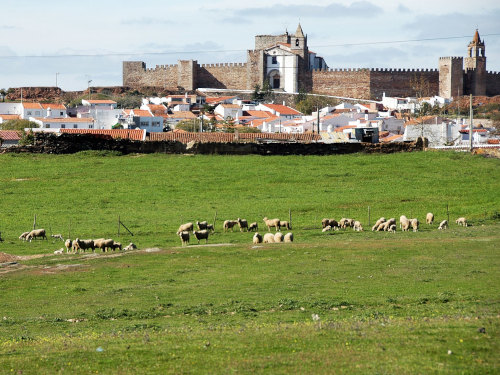
Castle of Mourão

Parish of Mourão

Mourão
District Évora
Council Mourão
Parish Mourão
Area 2678,63 km²
Inhabitants 2 351 (2021)
Density 8,4 hab./km²
Gentilic Mouranense
Construction 1223-1248
Reign Sancho II
Style Gothic
Conservation ( )

The region in which the town of Mourão is located encompasses a great spatial-temporal diversity. in relation to human presence. The current knowledge about the populations that lived and circulated in this space reveal that the area, both the closest (banks) as the furthest (town and parishes of Mourão) from the Guadiana river, experienced a continuous occupation of human groups from prehistory to the present day, with the river and its tributaries motivating and determining factors for the existence of traces of such occupation. The river thus attracted to its banks activities that are essential or complementary to traditional cycle of economic subsistence.

Since the prehistoric period, this area has presented diverse and abundant records of human presence. Places like Barca, Quinta da Fidalga and Agualta, Mercador and Porto das Carretas, among others, attest to such presence, visible in the lithic industries, in the remains ceramics, in rock art manifestations and in megalithic monuments, such as the Anta da old cellulose factory (Portucel).

The most notable presence of the Romans in the territory of Mourão was in the surroundings of old village of Luz. Lousa Castle, a fortified building from the Roman period (1st century the. C.), was the most visible element of the Roman heritage in the municipality. At the moment is submerged, and can be visited virtually through a CD-ROM, produced by EDIA, S.A., which records its memory.

Between this period and the medieval period, Mourão's human characterization is uncertain. With your historical origins lost in time and shrouded in tradition, the primitive village of Mourão would have been located, eventually, in the so-called Vila Velha. This was the subject of excavations archaeological, before being submerged by the waters of the Guadiana, recording the existence of a necropolis associated with a church, as well as the identification of a residential area of large dimensions.

In the medieval period there are references to Mourão, but his ownership is presented as a element that integrates the lack of definition of borders between the different kingdoms resulting from the Christian reconquest, now belonging to the kings of Castile and Leon, now under the rule of the kingdom of Portugal.

The prior of the Hospital Order, D.Gonçalo Egas, granted Mourão its first charter in 1226 and Denis of Portugal, confirmed it on January 27, 1296. This king recognized, in the meeting of Salamanca (1298), D.Teresa Gil as lady of the town, Mourão passing to the crown Portuguese after his death.

After the funeral of D.Teresa Gil, the Portuguese king granted a Spanish nobleman, D. Raimundo de Cardona, the privilege of being able to buy Mourão, a fact that was consummated in 1313, contracting a large loan from a Jew. Given the impossibility of honorably fulfill the commitments made, Mourão Square was once again subjected to auction, on April 19, 1317, on the porch of the Church of Our Lady of Tojal, being this once acquired by a merchant from Monsaraz, named Martim Silvestre, for 11,000 pounds. However, given the social incompatibilities between the merchant and the king, the latter will demand the its return for the same purchase price, making a new concession to D.Raimundo and his son William of Cardona.

In relation to the crisis of 1383-85, the Mourão square joined the cause of the Master of Avis, as is referred to in Fernão Lopes' chronicle, having been the target of devastating Castilian incursions.

As regards the mayorship of Mourão, this was assigned by the future king John II of Portugal to Diogo de Mendonça, being in this family until the reign of Afonso VI of Portugal. When the establishment of the dualist monarchy (1580), Mourão, through his mayor Francisco de Mendonça, joined the Spanish cause. After 60 years, the village passed, in the person of Pedro de Mendonça Furtado, on the side of the conspirators. The heir to the mayorship of Mourão, friend close to the Duke of Braganza, he felt the need to dignify the image of his family, being one of the first conspirators to take part in the events that led to the 1st of December, in 1640.

After the Restoration, as part of the wars of independence, Mourão suffered the impact of frequent border skirmishes, with its square being ravaged by the enemy army in several occasions. It is worth highlighting the siege of the same by the army of the Duke of S. German, during which, under the command of Captain João Ferreira da Cunha, the square managed to resist for only six days, thus revealing the fragility of the castle walls. Given that the reconquest of Mourão became a frontier priority, the queen regent, d. Luísa de Gusmão, was deeply involved in taking the town from the Spanish, which occurred October 29, 1657. Joane Mendes de played a decisive role in this reconquest. Vasconcelos.

In the 18th century, Mourão suffered the effects of the 1755 earthquake, which, together with the works to arrange, expand and consolidate the castle's defensive structure, started in the 17th century, and the state of destruction left by enemies led to the redesign of the urban layout of the village.

In the 19th century, the new administrative reform led to the creation of new municipal boundaries, which in the case of Mourão contributed to its extinction and annexation to the municipality of Reguengos de Monsaraz, by decree of October 24, 1853. In 1861, the municipality of Mourão has been reestablished again.

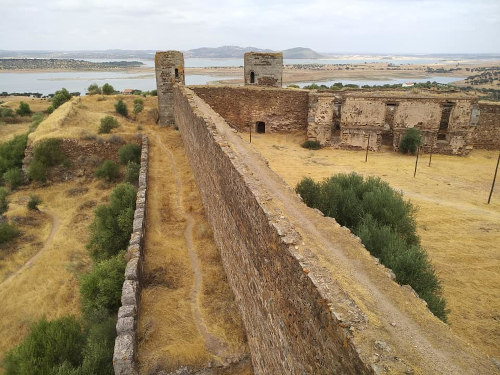
Mourão is currently surrounded by the water of Alqueva, outlining this new resource natural as one of the engines of sustained economic development of this location and of the municipality.

Background

Brasão de Mourão


Little is known about the early occupation of this site, other than that, at the time of the Reconquista Christian part of the Iberian Peninsula, was the scene of clashes between Muslims and Christians, when depopulated.

The medieval castleseta_baixoseta_cima

Following the Portuguese conquest of the region, its domains were donated to the Knights of the Order of the Hospitallers, with its Prior, Gonçalo Egas, being attributed with the granting of the first Charter of Charter to the town, aiming to encourage its settlement and defense (1226). It will date from this period, under the reign of Sancho II of Portugal (1223-1248), the construction or reconstruction of the fortification.

A new charter was granted to the town by Afonso III of Portugal (1248-1279), in 1254.

Under the reign of Denis of Portugal (1279-1325), the town of Mourão received a new charter (1296), confirmed in 1298. During this period, the original castle was renovated and now has three towers.

During the crisis of 1383-1385, the town and its castle stood out in the fight for the Master of Avis.

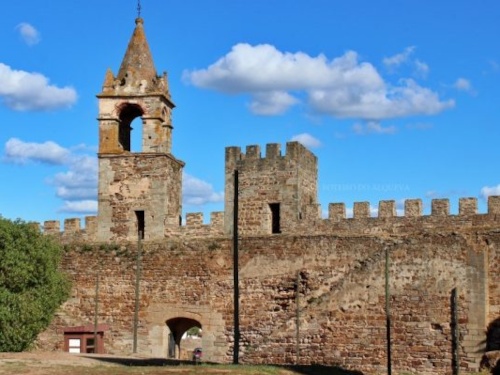
Later, under the reign of Manuel I of Portugal (1495-1521), the town and its castle were depicted by Duarte de Armas (Book of Fortresses, c. 1509). Received the New Charter from the sovereign, from when it experienced a new wave of reforms, with the design of military architects Diogo and Francisco de Arruda, master of royal works in the region of Antre-Tejo and Odiana. Date of this period, in the 16th century, the construction of the main church, within the walled enclosure.

From the Philippine Dynasty to the present dayseta_baixoseta_cima


Whether the town and Castle of Mourão adhered to Philip II of Spain during the succession crisis from 1580, when the Restoration of Independence (1640), however, Pedro de Mendonça Furtado was one of the first to raise the banner of John IV of Portugal (1640-1656). Its fortification was, from then on, reformulated with a project by the French military architect Nicolau de Langres, comprising four new bastions, ravelins and a moat, of which few remain today traces.

It is classified as a Property of Public Interest by Decree published on 18th July 1957.

In good condition, the castle is a tourist attraction valued by the community.

Architectureseta_cima

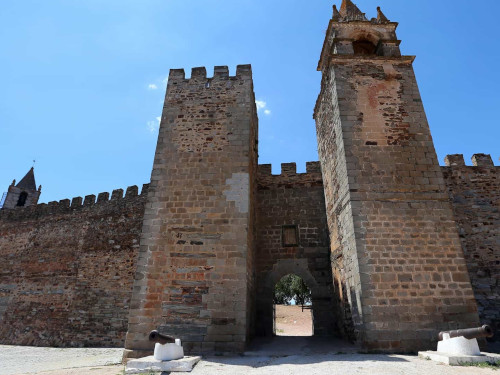
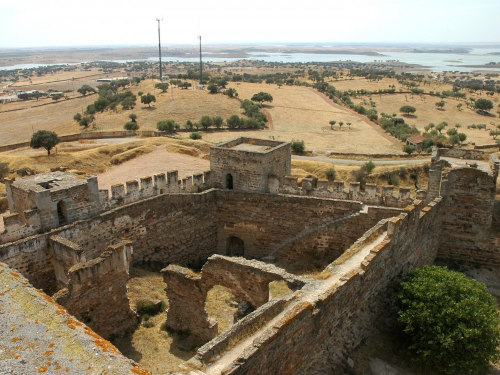
The castle is made up of a medieval wall, built in a curious arrangement that combines stones of shale, marble and granite, reinforced by six quadrangular towers. In it the doors, flanked by Gothic style towers, the main one stands out, with a door opening onto the parade ground.

Inside the fence, there are remains of the Guard House and the old Town Hall.

The 17th century renovations included bastions at the four corners of the wall and ravelins in front of the curtains.

Events of the time


1220 - By order of King D. Afonso II of Portugal the first Pesquisas were carried out in Portugal.

1222 - Consecration of the Monastery of Alcobaça.
 - Sancho II succeeds Afonso II as King of Portugal.

1233 - Establishment of Inquisition.

1235 - Marriage of Infante D. Afonso, future King D. Afonso III of Portugal with D. Matilde II of Bologna.

1250 - August 15 - Afonso III of Portugal signs in Évora the charter of the Village of Torres Vedras.

 - Afonso III of Portugal gathers the Cortes in Guimarães to hear the clergy's complaints against banditry and disorder in many places in the kingdom and against the violence of royal officials.

 - Albert the Great studied the properties of Arsenic

1255 -Lisbon becomes the capital of the Kingdom of Portugal.

1270 - End of the Eighth crusade.

 - Donation of the Lordship of Portalegre, Marvão, Arronches and Vide to Afonso de Portugal, brother of D. Denis.

1273 - Foundation of the city of Montalegre, in Portugal.

1275 - The Venetian Marco Polo arrives in Beijing, China.

1278 - D. Afonso III hands over the government of the kingdom to D. Denis.

1279 - D. Dinis becomes king of Portugal.

1295 - Jacques de Molay assumes the position of Grand Master of the Order of the Knights Templar.