Background
Early human occupation of this site possibly dates back to a prehistoric fort Romanized, according to the abundant archaeological evidence in the region. At this point were the Roman roads from Santarém and the mouth of the Tagus River, continuing through Évora to Merida. The place would have been fortified for this reason.
Centuries later, at the time of the Muslim invasion of the Iberian Peninsula, the name Almançor remained, in the region, in the toponymy of the Almansor river. Some authors claim that here there was also a Muslim fortification.
The medieval castle

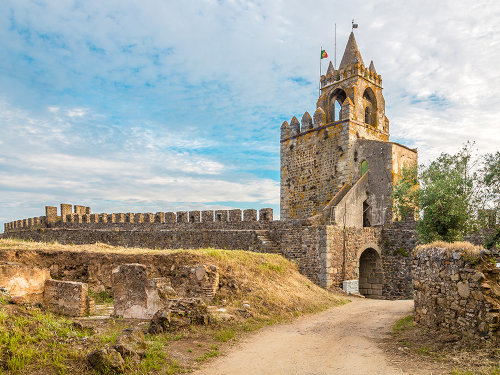
At the time of the Christian reconquest of the Iberian Peninsula, the town was conquered by the forces Portuguese under the command of Sancho I of Portugal (1185-1211). Aiming at its repopulation and defense, the sovereign granted it a Charter in 1203. It is believed that the construction of the medieval castle has begun at this stage.
During the time of Denis of Portugal (1279-1325) major reforms were initiated in the town's defenses, among which the construction of the village fence, completed in 1365.
Once the Avis dynasty was established, the domain of Montemor-o-Novo constituted a third of the lordship of Constable D.À época da Nuno Álvares Pereira .
Throughout the 15th century, the castle underwent renovations, work carried out by the master of Afonso Mendes de Oliveira's stonework. In the 15th and 16th centuries, the village reached its greatest prosperity, due not only to regional trade, but also to the fact that the Court remained for long periods in Évora, which made the town the stage for events such as the Cortes of 1495, when Manuel I of Portugal (1495-1521) took the decision to discover the sea route to India. This sovereign granted a new charter to the town in 1503. Later, under the reign of D. Sebastião (1557-1578), was granted the title of Notable Village (1563), considering that it was ancient place with a large population.
From the Portuguese Restoration War to the
present day
In the context of the War of Restoration of Portuguese independence, the War Council of D.João IV (1640-1656), gave orders for the rebuilding of its defenses.
During the earthquake of 1755, the space within the walls was already quite degraded, It is believed that the effects of the earthquake contributed to accelerating the decay process of the defenses. For this reason, the complex underwent repairs in the 18th century.
During the Peninsular War, the garrison of the old medieval fortification resisted the troops Napoleonic battles under the command of Junot, with combat taking place near the so-called Lisbon Bridge (1808). A few years later, during the Portuguese Civil War (1828-1834), the general staff of the liberal troops, under the command of Marshal Duke of Saldanha.
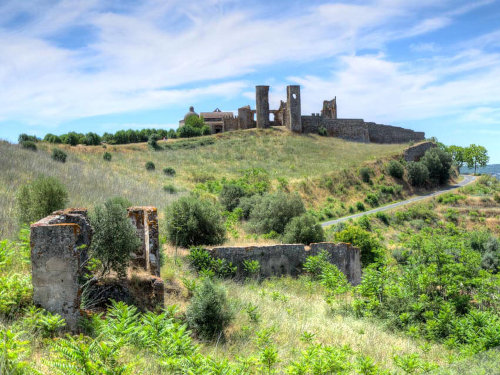
In the 20th century, in 1929, repairs were carried out on one of the towers, recording the collapse of walls and sections of walls in the following years. New repair works had place between 1937 and 1945, when two sections of the collapsed walls were rebuilt and consolidated the cloth next to the Porta da Vila.
The Castle of Montemor-o-Novo, including the walls and the buildings within them is classified as a national monument by Decree No. 38 147 of 5 January 1951. Brazilian government intervention was resumed in the 1960s, continuing intermittently through the 1970s and 1980s. In this last period, archaeological research that was resumed between 1992 and 1993. More recently, to the recovery of the so-called Tower of Bad Hour.
Architecture
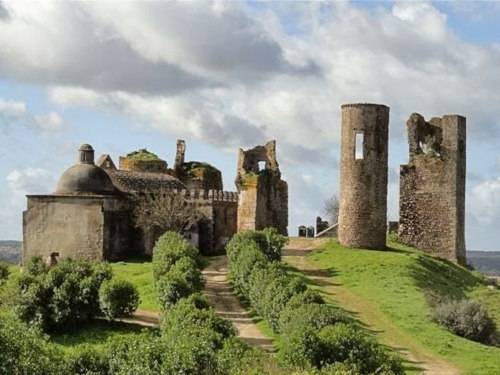
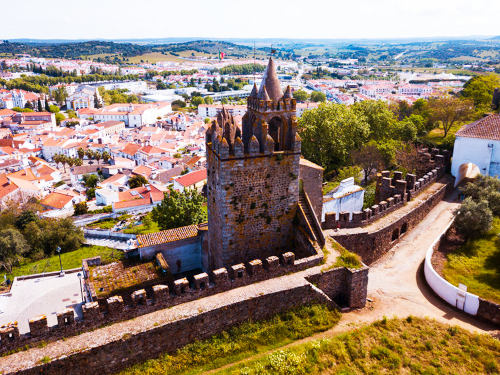
It has an irregular triangular plan. The wall facing north was originally torn by a door, now gone, known as the Évora Door. Access is made currently by the so-called Porta da Vila, Porta de Santarém or Porta Nova, to the north, flanked by called Clock Tower, square in plan, with a broken arch door.
Externally, the Guard House is attached, with a vaulted ceiling, whose arched gate is topped by the coat of arms of D.Manuel I.
In the western section of the walls, there is the so-called Bishop's Gate or Angel's Gate, defended by two square towers.
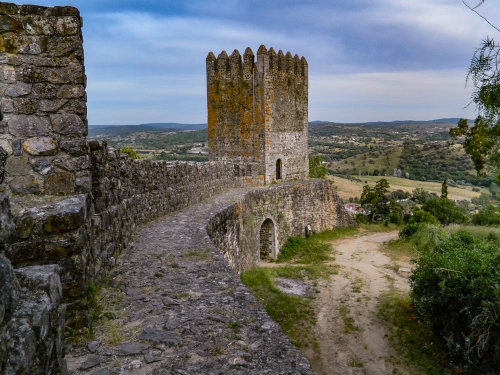
To the east, the Porta de Santiago or Puerta do Sol opens, flanked by the Torre da Má Hora, with a plan square, topped by pyramidal battlements.
In the castle's parade ground, the old cistern opens up and the façade of the old Palace rises. Mayor, today in ruins. Under the shelter of the village fence, the Church of São João Baptista stands out, the Church of Santiago, the Convent of Our Lady of Saudação and the ruins of the Church of Santa Mary of the Bishop.
Events of the time
1180 - Almohad
invasion of Portugal by the
Caliph Abu Ya'qub
Yusuf.
- Defeat of Prince D. Sancho in the Battle of Arganal, near Ciudad Rodrigo,
before
the army of the kingdom of León.
July 29 - Date indicated as the first naval battle between a Portuguese
armada, commanded by D.
Fuas Roupinho, and an Arab
force, led by Ben
Jami, off Cape Espichel.
1183 - Creation of the Inquisition through
the Council of
Verona.
1185 - Sancho I succeeds Afonso I of Portugal as king of Portugal.
- Construction of the Cathedral of
Évora.
1187 - October 2 - Saladin conquers Jerusalem from the
Crusaders; in response, Pope Gregory
VIII proposes launching the Third
Crusade.
- Sancho
I grants a charter
to Viseu, Avô,
Folgosinho, Bragança and Penarroias.
1273 - Foundation of the city of Montalegre, in Portugal.
1275 - The Venetian Marco Polo
arrives in Beijing, China.
1278 - D. Afonso III hands over the government of
the kingdom to D. Denis.
1279 - D. Dinis becomes king of Portugal.
- The first references to the Azores archipelago originate from sea
voyages made by Europeans in the 14th century,
namely from Portugal during the reigns of D. Dinis (1279-1325) and his successor,
Afonso IV.
- In Portugal, King D. Dinis begins the process of requalifying the
walls of Braga. The works will continue until around 1325.
1281 - Beginning of the armed struggle between D.
Dinis and the
infante D. Afonso, his brother.
- D. Dinis offered the town of Monforte to his daughter
D. Isabel as a dowry at
her wedding.
1282 - June 26 - Wedding, in Trancoso, of D. Dinis, King of Portugal and
Isabel of Aragon.
- Agreement between D. Dinis and his brother Afonso, in Badajoz.
Afonso promises to destroy the walls he had built, be knighted and become his vassal.