Background
Some authors argue that the primitive Monção site is located on an elevation, about two kilometers to the west, on the banks of the Minho River, where today the village of Cortes or Monção stands Old. More recent work does not clarify this possibility, but rather confirms that the The town (and its defense) is not mentioned in documents relating to the reign of D. Afonso Henriques (1112-1185), raising the hypothesis that the first defense of the town dates back to to the reign of Sancho I of Portugal (1185-1211), which is not supported by material evidence.
The medieval castle


Under the reign of Afonso III of Portugal (1248-1279), Monção appears as a town in the Inquisitions of 1258. On the other hand, the Charter of Foral (issued on March 12, 1261) allows us to infer that the town was refounded ("...facio quandam populatianem in cauto de Maazedo e imposeo ei again nomen Monzon."). Once again, this text allows us to infer that the village was already fortified, mention the miles of Monçom, which is also questioned by some scholars, under the argument of demographic scarcity in the region at the time.
Those who defend the argument that the fortification did not exist under Afonso III of Portugal, accept that it was Denis of Portugal (1279-1325) was responsible for the construction of the Monção Castle (1306), supported by Rui de Pina, who stated this in his column. At this time, the town received a Charter of Fair and were work on the main church began. Economic and demographic development has made the population, so that, under the reign of Fernando I of Portugal (1367-1383), he entered into war with Henry II of Castile, the Castilian forces invaded the kingdom of Portugal, besieging Monsoon (1369).

With the death of Fernando I of Portugal, when the crisis of 1383-1385 began, the good men of Vila Nova de Cerveira, Caminha and Monção sent messages to Constable D.À época da Nuno Álvares Pereira , declaring themselves true Portuguese and voluntarily handing over these towns and their castles. At some point in the 15th century, probably under the reign of John I of Portugal (1385-1433), the castle was equipped with a surrounding armor.
Under the reign of Manuel I of Portugal (1495-1521), the town and its castle are represented by Duarte de Armas (Book of Fortresses, c. 1509).
From the Portuguese Restoration War to the
present day
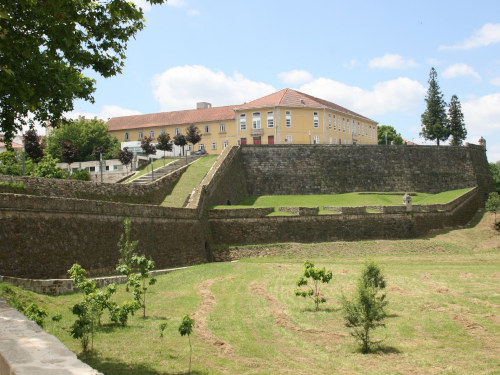
In the context of the War of Restoration of Portuguese independence, it became imperative to modernize the town's defenses, which were then converted into a fortress with a bastioned polygonal plan. Started in 1656, with a project by the engineer French military Miguel de L'Ècole, under the direction of master João Alves do Rego, these defenses, adapted to artillery fire, they resisted steadfastly from October 1658 to 7 February 1659, when the exhausted garrison finally asked for surrender.
It is classified as a National Monument by Decree published on October 23, 1910.
Architecture
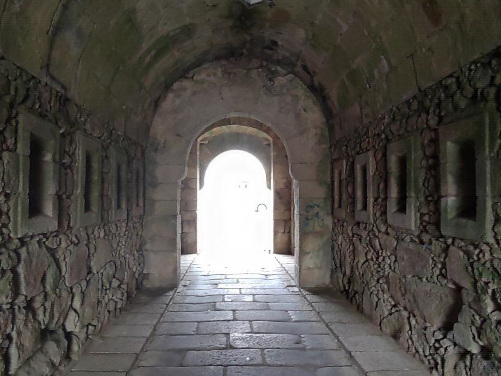
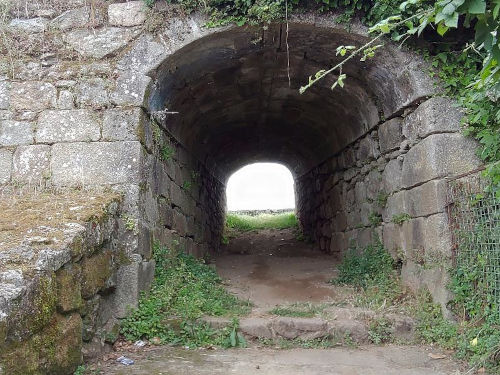
The set has a circular plan, in the style Gothic, surrounding the medieval village. Only two doors were torn into the walls, main one defended by the Keep Tower, opening onto the grounds where the fair. The smaller treason gate opened onto the riverside area.
The fortification built in the 17th century, although built from scratch, was part of the medieval walls, reformulating them, given the growth of the village. In this way, nine bastions and five gates, maintaining large areas without buildings, facilitating the movement of troops and artillery.
Events of the time
1297 - September 12 - The Treaty of
Alcanises defines the
border between Portugal and Castile.
1299 - Osmã
I creates
the Ottoman
Empire, which will
last until 1922.
- Foundation of the municipality (by charter) of Vila Nova de Foz
Côa.
1302 - September 26 — The templars lose the
island of Ruad which thus
becomes the last stronghold
of cruzados na Holy Land.
1305 - The Templars are threatened in France by King
Philippe the
Handsome.
1307 - Portugal's activities in the so-called "Ocean Sea" began with
the king Denis
of Portugal I of Portugal,
from the appointment of Admiral, Nuno
Fernandes Cogominho.
- General Study Foundation, d. 1537 University of
Coimbra.
1308 - March 9 - First charter to Póvoa de Varzim by Denis of
Portugal of
Portugal orders the installation of a "póvoa" on its lands in Varazim.
- A University of Coimbra was
installed in Coimbra, in the Royal Palace of Alcáçova.
1309 - September 12 — marriage of the Infante D. Afonso, future King D.
Afonso IV of
Portugal with Beatriz de
Castile.
1310 - April 6 - The Scots reassert their independence by signing the
Declaration of
Arbroath.
1319 - March 14 - canonically instituted Order
of the Militia of Our Lord Jesus Christ, or Order of Christ, founded by the bull "Ad ea
ex
quibus" Pope John XXII.
1323 - Denis of Portugal confronts Alfonso IV of Portugal in what happened
to be designated as Battle of
Alvalade, which would be interrupted before its start by Queen
Saint Elizabeth