Background
It is to the reign of Denis of Portugal and the turn of the 14th
century that the
construction of the
castle. Unfortunately, little remains of him. In 1530, less than a century after it was
renovated, the structure already showed signs of ruin, with multiple parts knocked down. To the
references to the monument's decline became more pronounced in modern times and, in 1706,
Carvalho da Costa
also mentions the existence of three gates - Porta or Arco de Santiago; Saint Anthony's Gate and
St. Joseph's Gate.
The medieval castle

The first documentary reference to Mirandela testifies to the presence of Sancho I of Portugal (1185-1211), during the siege imposed on Bragança by the forces of King Afonso IX of Leon (1198).
During the reign of Afonso III of Portugal (1248-1279), the granting of a Charter to village (May 25, 1250).
The first major construction campaign experienced by the town dates back to the reign of D. Dinis (1279-1325), when the village was transferred to its current location (1282). THE The sovereign granted it a new charter, delimiting the boundaries of the Council (Coimbra, 7 March of 1291) and establishing a fair (c. 1295). It is believed that the sovereign determined build a castle on top of the hill, where the Távora Palace was later built, and the village fence. This castle would consist of a simple keep protected by a Barbican.
During the crisis of 1383-1385 the town and its castle sided with the Master of Avis.
Manuel I of Portugal (1495-1521) gave it a New Charter, issued in Lisbon on 1 July 1512. early 18th century, Father António Carvalho da Costa recorded: The villa of Mirandela surrounded and the fence in parts derived (Portuguese Chorography and description) topographical view of the famous Kingdom of Portugal. Lisbon, 1712.) Another contemporary author, J. Alvarez Colmenar, refers to Mirandela as being located on the banks of the Tuela River, defended by a castle (1715).
With the loss of its strategic-defensive function, and the economic development of the region, the urban progress broke the belt of medieval walls, which gave way to streets and new sunny residences, a process that accelerated in the last quarter of the 19th century.
In our days
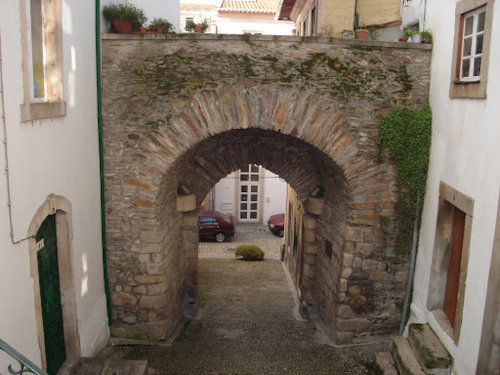
The remains of the medieval enclosure, represented by the so-called Porta de Santo Antônio, were listed as a Property of Public Interest by Decree published on October 20, 1955.
Mirandela was elevated to the status of city in 1984.
Architecture
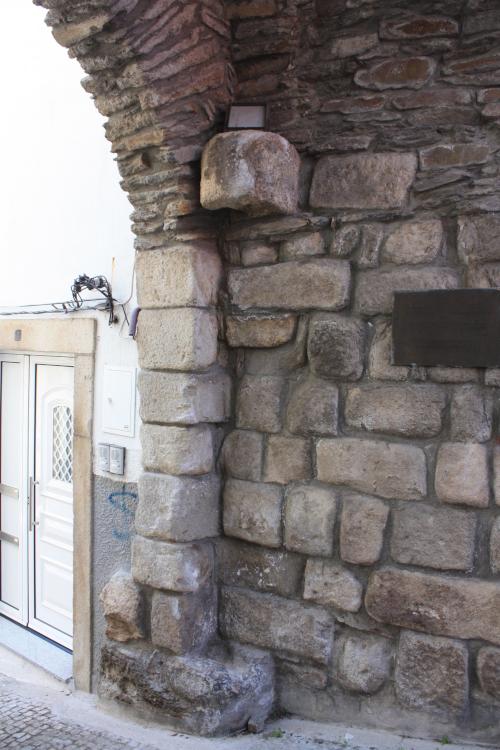
The Porta de Santo Antônio is the remaining one of a set of three that were torn into the
fence
medieval village. In a raised pointed ogival arch, in granite and mortared schist stonework,
with dimensions of 2.60 m high by 1.80 m wide, it is topped by the terrace of a
residence in private hands, but which corresponds to a section of the original battlement.
Through
it, the Street of
Santo Antônio, the busiest part of the medieval village, was connected to the bridge (built in
the 14th century).
and with the river.
On the inside of the arch you can still see the grooves that received the hinges of the old iron gate.
There are still traces of sections of the wall, just a few rows of stone, visible supporting the bow. Opposite this door, approximately fifteen meters away, another opened, in a remnant of a Barbican, demolished in 1884, to build a family mansion in its place Araujo Leite.
Events of the time
1238 - Conquest of Mértola by the Kingdom of Portugal.
1242 - Conquests of Tavira and Paderne.
1244 - March 16 - Over 200 Cathars
are burned at
Montségur,
ending the Albigensian Crusade.
1247 - Abdication of Sancho II of Portugal,
paving the way for the coronation of the Count of Bologna,
future Afonso
III of Portugal, going into exile in Toledo, where he would die.
1249 - Afonso III of Portugal takes Faro, Albufeira, Porches and Silves,
marking the end of the Portuguese reconquest.
1250 - August 15 - Afonso III of Portugal signs in Évora the charter of
the
Village
of Torres Vedras.
- Afonso III of Portugal
gathers the Cortes in Guimarães to hear the clergy's complaints against banditry and disorder in
many places in the kingdom
and against the violence of royal officials.
- Albert the Great studied the
properties of Arsenic
1253 - Afonso III of Portugal publishes the Almotaçaria Law, a measure
that
aims to set prices, prohibiting the export of cereals and precious metals.
1255 -Lisbon becomes the capital of the Kingdom of Portugal.
1258 - Carrying out Inquirições,
which when compiled would become one of the most curious monuments of Portuguese medieval
documentation.
1259 - The kings of England recognize the loss of the Duchy of
Normandy
and its annexation to the kingdom of France. Henry
III of England
no longer has the nominal title of Duke of Normandy.
1263 - Agreement of
Afonso III of Portugal with the King of Castile concerning the Algarve.