Background
Archaeological prospecting has shown that primitive human occupation of this site dates back to a Gallo-Celtic castro, used by the Romans who urbanized it from the 2nd century BC, having in view of the fact that some of the roads that crossed the south of the Iberian Peninsula were located there. THE The town was then known by the name of Helvas. Some authors understand it to be testimony from this period a door inside the castle, to which they attribute constructive characteristics Roman.
Later the village was occupied by Visigoths and, from 714 onwards, by Muslims who, naming it Ielbax, they built the first two belts of walls, of which traces remain to this day.
The medieval castle

At the time of the Christian À época da Reconquest of the Peninsula, it would have been initially taken by Christian forces under the command of Geraldo Sem Pavor (c. 1166), during the conquest of Juromenha. Resumed by the Moors, returned to Portuguese hands in 1220 to once again fall into Moorish possession. Only in 1226 (1228 or 1229 according to other authors) it fell definitively into Portuguese hands, under the reign of Sancho II of Portugal (1223-1248), who granted it a Charter (May 1229) and determined its reconstruction and reinforcement of defenses. Some authors understand that these works would be completed as early as 1228.
Conflicts over possession of this border spanned the reigns of:
- Denis of Portugal (1279-1325), who gave the town a charter (1231) and expanded its defenses;
- Fernando I of Portugal (1367-1383), who provided it with a third belt of walls, reinforced by towers;
- John II of Portugal (1481-1495), who ordered the reconstruction of the Keep (1488) and others repairs, as per the coat of arms of this sovereign over the entrance gate; and
- Manuel I of Portugal (1495-1521), who elevated the town to the status of city (1513).
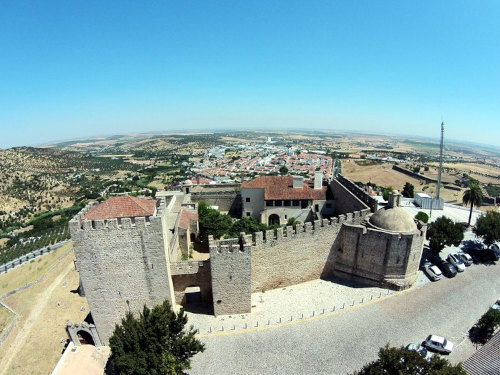
Overall, these sovereigns provided the town with a remarkable defensive system, which at the beginning of the 16th century boasted a triple belt of walls, twenty-two towers, eleven gates and a Barbican, according to the drawing by Duarte de Armas (Book of Fortresses, c. 1509). These last two sovereigns were responsible for modernizing the castle to the bastioned system, with Renaissance lines, a period in which the residential function began to predominate (palace of mayors).
During the Crisis of 1383-1385, the mayor of Elvas sided with D.Beatriz and Castile. Meanwhile, the population, led by Gil Fernandes, attacked the castle and detained its mayor. Gil Fernandes swore allegiance to Portugal and to John I of Portugal, provoking, in the summer of 1385, a siege of twenty-five days by the Castilian forces, which the town resisted undefeated.
He was unable to do the same in the context of the Succession Crisis of 1580, when his mayor went over to the Spanish side, it is said that in exchange for gold, returning to Portuguese rule after the Restoration of Independence.
From the Portuguese Restoration War to the
present day
With the restoration proclaimed, the city soon had its defense modernized, adapted to gunfire of the artillery. It thus received a new line of walls, with a bastioned polygonal layout, whose work would only be completed in the first decade of the 18th century. transformed into a authentic stronghold, it resisted the Spanish siege of 1658, allowing it to be defeated in the battle of the Lines of Elvas (14 January 1659).
Although these modern defenses of Elvas have come down to us in a relative state of preservation, the same did not happen to medieval structures, where the effects of urban growth took their toll your price. The castle was the first property to be classified as a Monument National in the country, by Decree published since October 9, 1906.
The consolidation and restoration interventions that it has received from the public authorities since then they aimed to deliver it to the public, allowing for the improvement of its visitation over the decades and understanding. Likewise, the archaeological research carried out aimed to recover the testimonies about its evolution, correctly framing its different structures in the appropriate line of time and also allowing a better understanding.
Architecture
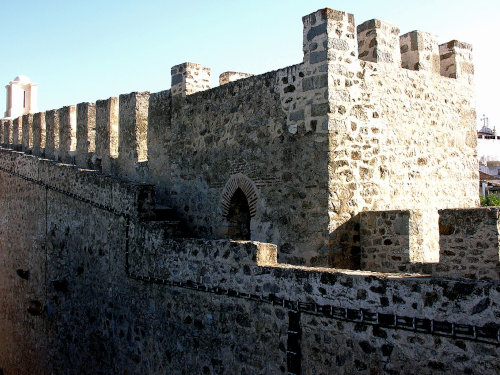
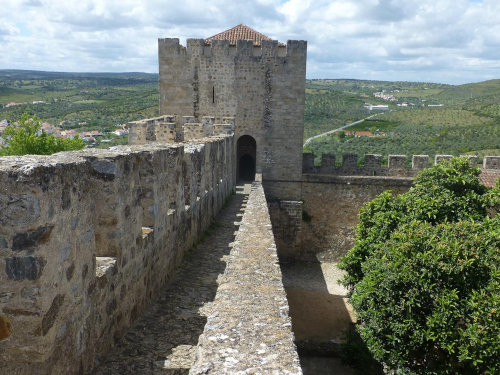
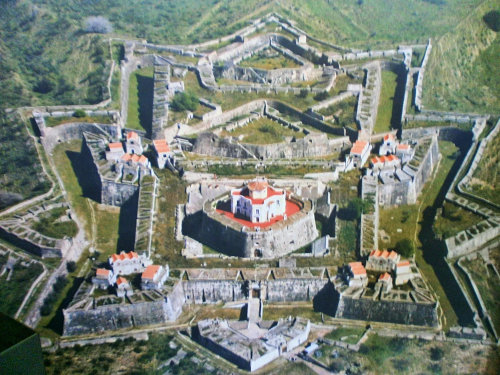
The medieval castle stands at the highest point of the land, 320 meters above sea level. As a whole, it presents elements from various construction periods, which, at the beginning of the Age Modern, it was composed of three defensive curtains, preserving the two oldest ones important structures of the Muslim period.
In the most recent external defense line, dating from the reign of Fernando I of Portugal, reinforced by twenty and two Turrets and a Barbican, originally opened eleven doors - reduced to three by 17th century reforms (respectively those of Évora, Olivença and São Vicente). This defense was partially absorbed by urban expansion.
The intermediate line of defense was also compromised by this expansion. Its walls were torn by four doors: the Ferrada, the Porta Nova or Encarnação, the Santiago and the Bishop.
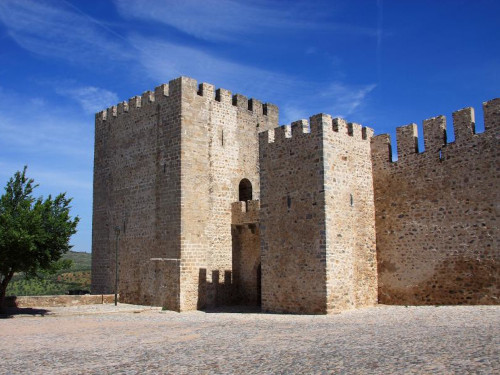
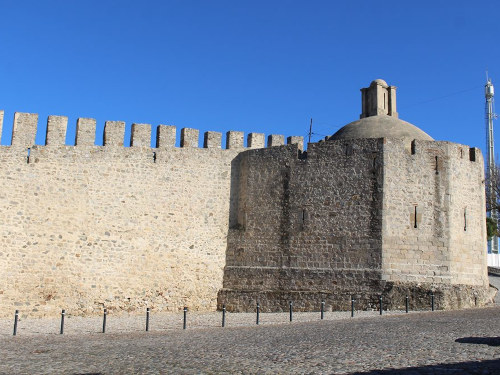
The internal defense line stands at the highest point of the terrain, to the northeast, having reached to us two of its old doors: the Alcáçova and the Miradeiro. It consists of the castle from the reign of Sancho II of Portugal, remodeled by Denis of Portugal and reinforced by John II of Portugal and D.Manuel I, presenting a quadrangular plan. Flanked by two quadrangular towers, the tallest corresponding to the keep, the Arms Gate is protected by a balcony supported by Corbels, where the coat of arms of John II of Portugal is displayed. In its crenellated walls stands a tower Irregular hexagonal shape, torn by apertures and covered by a semi-spherical dome. THE The top of this tower is covered by a battlement protected by a parapet with wide battlements. In the square of arms the various architectural fragments, reveal the different construction periods and stylistic.
Events of the time
1226 - Sancho II of Portugal,
taking advantage of the wars of Afonso IX of Leon
against the Muslims, tries to conquer Elvas without success.
1229 - Sancho II of Portugal occupies Elvas, granting
it a charter. Advances continued,
conquering Juromenha.
1231 -April 2 - The Agreement of Sabugal was signed between Sancho II of
Portugal
and Fernando III of León and
Castile, by which Chaves was returned to Portugal.
1232 - Capture of Moura and Serpa by the Portuguese.
1233 - Establishment of Inquisition.
1235 - Marriage of Infante D. Afonso, future King D. Afonso III of Portugal
with D. Matilde II of Bologna.
1236 - Volga River region conquered by the Mongols, led by Batu
Khan.
1238 - Conquest of Mértola by the Kingdom of Portugal.
1242 - Conquests of Tavira and Paderne.
1244 - March 16 - Over 200 Cathars
are burned at Montségur,
ending the Albigensian Crusade.
1247 - Abdication of Sancho II of Portugal,
paving the way for the coronation of the Count of Bologna,
future Afonso
III of Portugal, going into exile in Toledo, where he would die.
1249 - Afonso III of Portugal takes Faro, Albufeira, Porches and Silves,
marking the end of the Portuguese reconquest.
1250 - Afonso III of Portugal
gathers the Cortes in Guimarães to hear the clergy's complaints against banditry and disorder in
many places in the kingdom
and against the violence of royal officials.
1253 - Afonso III of Portugal publishes the Almotaçaria Law, a measure
that aims to set prices, prohibiting the export of cereals and precious metals.
1255 -Lisbon becomes the capital of the Kingdom of Portugal.
1258 - Carrying out Inquirições,
which when compiled would become one of the most curious monuments of Portuguese medieval
documentation.
1259 - The kings of England recognize the loss of the Duchy of Normandy
and its annexation to the kingdom of France. Henry III of England
no longer has the nominal title of Duke of Normandy.
1263 - Agreement of
Afonso III of Portugal with the King of Castile concerning the Algarve.
- Papal legitimization of the marriage of Afonso III of Portugal with D.
Beatriz.
1264 -Renunciation of Afonso X of Castile's rights over the Algarve.