Background
The Castle was built in the 13th century and donated to the Military Order of Aviz in 1249, and was later rebuilt in 1293, during the reign of King Dinis.
The construction made use of the rocky outcrops as sections of the wall, connecting them to the wall itself, similar to many pre-medieval fortified settlements.
História

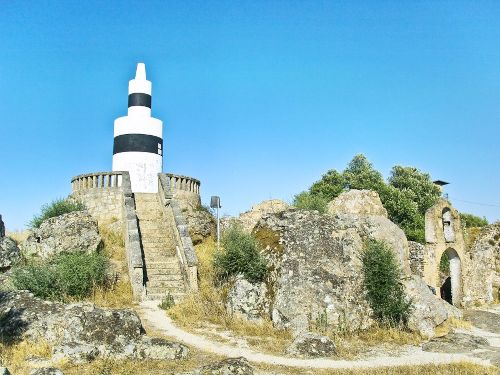
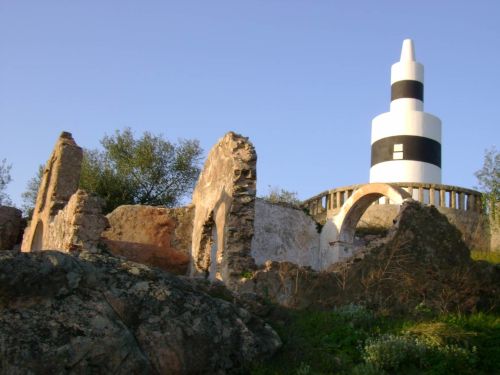
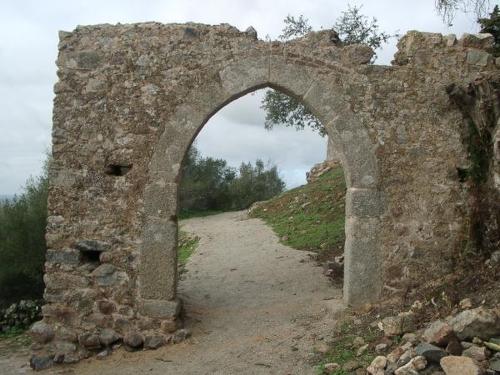
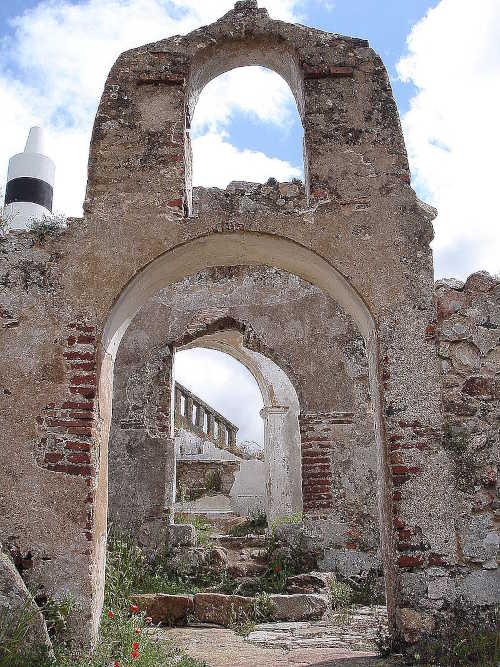
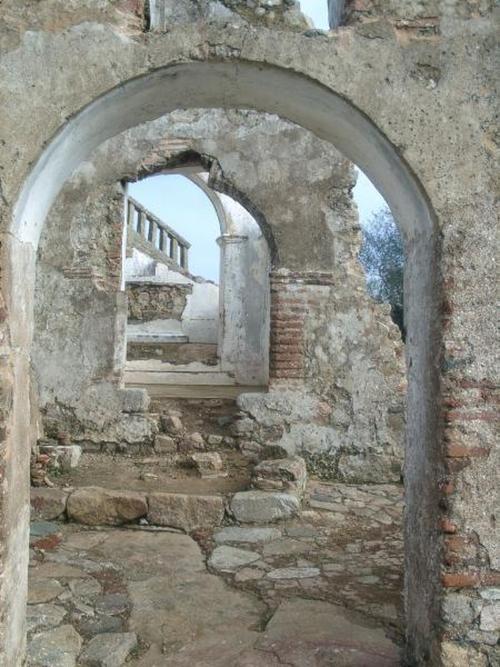
Its construction dates back to the 13th century, having been donated by Afonso III of Portugal (1248-1279) to the knights of the Military Order of Aviz. It was rebuilt by Dinis I of Portugal (1279-1325). At the time of the War of Restoration of Portuguese independence, it was surprised, in 1662, by Spanish forces under the command of D.João de Austria. Practically unguarded, it fell and was destroyed, turning into ruins. All that remains of the original structure is a Gothic-style portal, parts of the ruined wall and the door to the Chapel of São Bento inside. These remains were classified as Property of Public Interest by Decree published on September 29, 1977.
Features
It has a floor plan in the shape of a pentagonal polygon.
Remains of sections of wall and Turret, distributed over an elliptical area whose major axis (86 m) is oriented in the N./S. direction. The minor axis is 50 m long. The following remains are identifiable: base of a 13.5 m section of the wall to the W.; 3.30 m section of wall, N., connecting cliffs; small section of wall to the E., connecting cliffs; two sections of wall 1.60 m thick, 6.20 m and 10.5 m long, interconnected, forming an obtuse angle, ending in a cube 2.90 m in diameter, to the S. / SE.; base of wall, 16 m long, to the S, between the top of the old cemetery and the cubelo; castle door, with an ogival arch, to the S., with a granite stone frame, 1.90 m wide and 2.40 m high, with stone hinges and bolts on both sides, as well as holes for the lock; the gate still has a remnant of wall, perpendicular to its plane, heading in a NW direction.
Within the old castle enclosure there is today: to the E., a geodetic marker, marking 412.83 m at the base and 420.9 m at the top, in the centre of a circular viewpoint that enjoys a spectacular panorama; immediately below and to the W., the ruins of the hermitage of São Bento.
To the E., but to the S. of the viewpoint, what appears to be a small, dry cistern for collecting rainwater, 1.90 m deep; in the SE, S and SW sectors, in a clockwise direction, a fire observation post, the two sections of wall and Turret already mentioned, the municipal water tank, for the construction of which stone from the adjacent wall was used, and finally a disused cemetery.
Events of the time
1238 - Conquest of Mértola by the Kingdom of Portugal.
1244 - March 16 - Over 200 Cathars
are burned at
Montségur,
ending the Albigensian Crusade.
1247 - Abdication of Sancho II of Portugal,
paving the way for the coronation of the Count of Bologna,
future Afonso
III of Portugal, going into exile in Toledo, where he would die.
1249 - Afonso III of Portugal takes Faro, Albufeira, Porches and Silves,
marking the end of the Portuguese reconquest.
1250 - August 15 - Afonso III of Portugal signs in Évora the charter of
the
Village
of Torres Vedras.
- Afonso III of Portugal
gathers the Cortes in Guimarães to hear the clergy's complaints against banditry and disorder in
many places in the kingdom
and against the violence of royal officials.
- Albert the Great studied the
properties of Arsenic
1253 - Afonso III of Portugal publishes the Almotaçaria Law, a measure
that
aims to set prices, prohibiting the export of cereals and precious metals.
1255 -Lisbon becomes the capital of the Kingdom of Portugal.