Background
The human occupation of the site dates back to a prehistoric hill fort, which was subsequently succeeded by the Romans, the Suevi, the Visigoths and the Muslims, the latter being responsible for the original castle.
The existing settlement was called Talmeyda (table in Arabic), expressing the topography of its location, in contrast to the Marofa mountain range in the background, which in the same language meant "guide".
The medieval castle


At the time of the Christian À época da Reconquest of the Iberian Peninsula, the town and its castle were conquered by the forces of the Kingdom of León, reconquered by the Muslims and, finally, by the forces of Portugal.
Part of the territory of Ribacôa, disputed with León by Denis of Portugal (1279-1325), its definitive possession for Portugal was assured by the Treaty of Alcanices (1297). From then on, the sovereign sought to consolidate its borders, rebuilding the Castle of Alfaiates, the Castle of Almeida, the Castle of Good, the Castle of Melhor, the Castle of Mendo, the Castle of Rodrigo, the Castle of Pinhel, the Castle of Sabugal and the Castle of Vilar Maior.
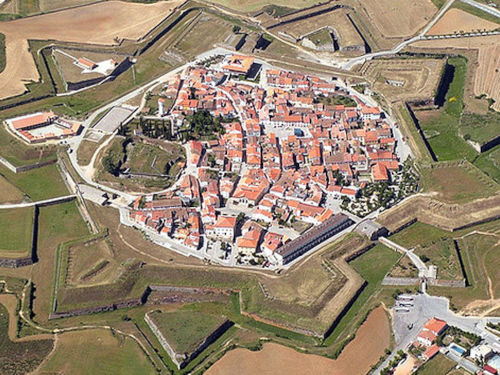
Thus, work began on rebuilding the original castle and a fence for the town, works that were renewed during the reign of Fernando I of Portugal (1367-83), who intended to attack Castile from this town.
In the context of the Crisis of 1383-1385, the town and its castle were conquered by the forces of John I of Portugal (1383-1433).
Later, under the reign of D.I (1495-1521), the line of walls was doubled, and the name of Mateus Fernandes, architect of the Batalha Monastery, was associated with these works. The town and its castle are depicted by Duarte de Armas (Book of Fortresses, c. 1509). Its mayor at the time (1496-1512) was the Marquis of Vila Real.
From the Portuguese Restoration War to the present day

In the context of the War of Restoration of Independence, the town and its old castle were revalued due to their strategic border position. They then underwent extensive modernization work, with bastioned structures, which transformed them into a monumental fortress.
At the time of the Peninsular War, the square was surrounded by French troops under the command of General André Masséna (August 1810). At the time, under enemy artillery fire, the gunpowder magazine exploded, destroying the medieval castle and part of the village, killing and injuring more than 500 people. The breaches opened in the walls by the impact of the explosion forced the capitulation of the square, which was then garrisoned by the French. A few months later, it was besieged again, this time by English troops. Cornered, the French defenders managed to withdraw, blowing up the square behind them, which caused extensive damage.

The complex is classified as a National Monument by Decree published on 3 February 1928.
Recent archaeological excavation work has uncovered not only sections of the ancient walls, but also the original moat that surrounded them.
Events of the time
1270 - End of the Eighth crusade.
- Donation of the Lordship of Portalegre, Marvão, Arronches and Vide
to Afonso de Portugal,
brother of D.
Denis.
1273 - Foundation of the city of Montalegre, in Portugal.
1275 - The Venetian Marco Polo
arrives in Beijing, China.
1278 - D. Afonso III hands over the government of
the kingdom to D. Denis.
- Independence of Andorra.
1279 - D. Dinis becomes king of Portugal.
- The first references to the Azores archipelago originate from sea
voyages made by Europeans in the 14th century,
namely from Portugal during the reigns of D. Dinis (1279-1325) and his successor,
Afonso IV.
1281 - Beginning of the armed struggle between D.
Dinis and the
infante D. Afonso, his brother.
- D. Dinis offered the town of Monforte to his daughter
D. Isabel as a dowry at
her wedding.
1282 - June 26 - Wedding, in Trancoso, of D. Dinis, King of Portugal and
Isabel of Aragon.
- Agreement between D. Dinis and his brother Afonso, in Badajoz.
Afonso promises to destroy the walls he had built, be knighted and become his vassal.