Background
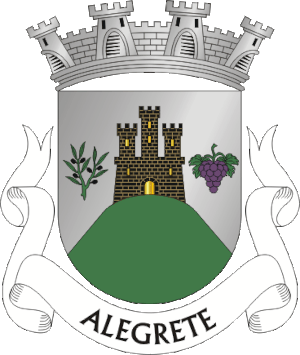
Strategically positioned, it was one of the most important fortifications in Alto Alentejo, a fundamental part of the region's defensive system in the Middle Ages. Currently, it has the potential to become an important tourist attraction for a region that is suffering from its inland location.
Although the earliest human occupation of the site is obscure, it is believed to date back to the time of the Lusitanians, succeeded by the Romans, the Vandals, the Alans and up until the Muslim invasion of the Iberian Peninsula, from the 8th century onwards.
The medieval castle

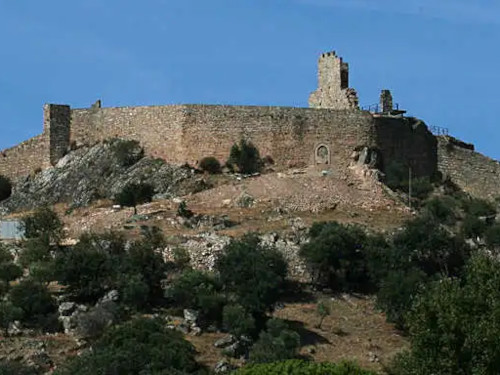
At the time of the Christian À época da Reconquest of the Iberian Peninsula, the town and its defences were conquered by the forces of Afonso I of Portugal (1112-1185), according to tradition, in 1160. However, the first documentary information about it dates back to the 13th century, since, under the terms of the Convention of Badajoz (16 February 1267), signed between Afonso III of Portugal (1248-1279) and his father-in-law, Afonso X of Castile, the town of Alegrete and its castle were definitively incorporated into the territory of Portugal. The Portuguese sovereign repaired and reinforced it, works that continued until the reign of Denis of Portugal (1279-1325), when the town received its Charter (1319).
In the context of the crisis of 1383-1385, the town and its castle sided with the Master of Avis, having been the camp of the Portuguese forces under the command of Constable D.Nuno Álvares Pereira (8 April 1384), victorious against Castile in the Battle of Atoleiros.
In the reign of Afonso V of Portugal (1438-1481), it was conquered by Castilian troops (1475). Back in Portuguese possession, the town received, on 14 February 1516, the New Charter from D. Manuel I (1495-1521).
Do século XVI ao XVIII
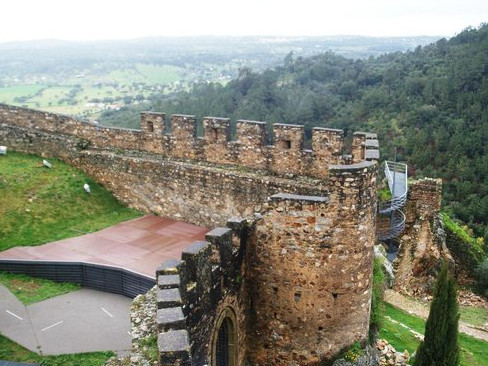
During the succession crisis of 1580, the position of the old medieval castle regained strategic importance, on the first line of border defense. Later, during the War of Restoration of Portuguese independence, John IV of Portugal (1640-1656) rewarded Matias de Albuquerque for services rendered by granting him the title of Count of Alegrete. In the same context, it is said that, in 1662, with the square of Alegrete garrisoned by two infantry companies under the command of La Coste, surrounded by Spanish troops under the command of D.João de Áustria, that governor of the square sent the invading commander two bottles of the region's generous wine, with a note informing that the Portuguese garrison would resist until the last drop of that drink produced there. Faced with this gesture of gallantry, it is said that the invader lifted the siege of the square and withdrew. From 1664 onwards, its defenses were modernized and reinforced at specific points, under the direction of the Marquis of Marialva. At the time, a bastioned campaign fortification, now gone, was built, probably during cleaning since it is not possible to identify its remains today. Also in that century, the Marquisate of Alegrete was created (August 19, 1687), with D.Manuel Teles da Silva as its first holder.
The 19th century: the Peninsular War and the Liberal Wars
At the beginning of the 18th century, the town and its fortifications resisted the siege by the troops of Philip V of Spain (1704), to plunge into a peace from which it would only emerge at the beginning of the following century, when it quartered a considerable number of troops at the time of the so-called War of the Oranges (1801). By this time its defences were already in considerable decline, and it had played no role in the fighting of the Liberal Wars that took place in its vicinity between the troops of the Count of Vila Flor and the royalists (1826).
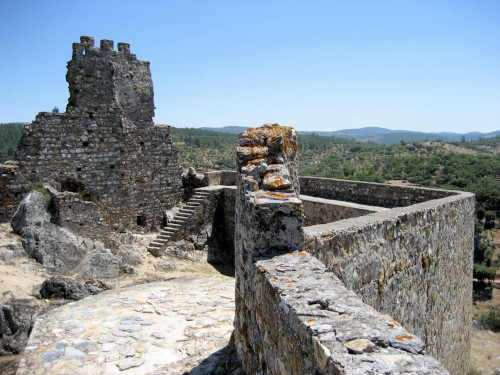
The Alcaidaria-Mor of Alegrete, with responsibility for the Castle, was handed over to the Counts of Vila-Flor and the Lords-Donatários of Zibreira, with the last lord of the castle being D.Cristóvão Manoel de Vilhena, Lord of Pancas and Zibreira, heir son of the Countess of Alpedrinha, who took office as Alcaidaria-Mor of Alegrete in 1860, and died in 1877, when the aforementioned Alcaidaria-Mor and the Castle of Alegrete reverted to the National Treasury.
From the 20th century to the present day
Since the Municipality and Court of Alegrete were suppressed (June 26, 1855), its castle has been abandoned and forgotten.
In the 20th century, it was classified as a National Monument by Decree/Law No. 35,443 of January 2, 1946, until, from 1965 onwards, consolidation and restoration works were started, under the responsibility of the General Directorate of National Buildings and Monuments (DGEMN). From 1977 onwards, consolidation works were carried out on the castle tower and masonry covering the openings and Battlements was demolished. Later, from 1984 onwards, work was carried out to consolidate the walls and isolate the entrance to the castle.
Despite the importance of the interventions carried out, the monument was awaiting a broader programme of enhancement, as it was in a precarious state of conservation. Plans for its recovery were recently under consideration.
Features
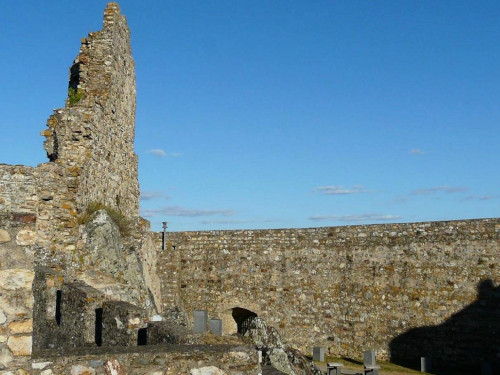
Example of Gothic military architecture, it has a rectangular, irregular plan. In its wall, to the south, there is a gate, defended by a small tower. On the walls, to the east, stands the keep, with a rectangular plan and two floors, associated with a cistern, which is part of the complex. The battlement, accessed by a stone staircase, is built into the ground and laid out transversely to the wall.
The defence was complemented by a fence surrounding the town, connecting it to the castle. In poor conservation conditions, among the few preserved sections, the Porta da Vila stands out, flanked by two defensive cubes, an example of the Gothic gates of the urban fences of the period.
Events of the time
1270 - End of the Eighth crusade.
- Donation of the Lordship of Portalegre, Marvão, Arronches and Vide
to Afonso de Portugal,
brother of D.
Denis.
1273 - Foundation of the city of Montalegre, in Portugal.
1275 - The Venetian Marco Polo
arrives in Beijing, China.
1278 - D. Afonso III hands over the government of
the kingdom to D. Denis.
- Independence of Andorra.
1279 - D. Dinis becomes king of Portugal.
- The first references to the Azores archipelago originate from sea
voyages made by Europeans in the 14th century,
namely from Portugal during the reigns of D. Dinis (1279-1325) and his successor,
Afonso IV.
- In Portugal, King D. Dinis begins the process of requalifying the
walls of Braga. The works will continue until around 1325.
1281 - Beginning of the armed struggle between D.
Dinis and the
infante D. Afonso, his brother.
- D. Dinis offered the town of Monforte to his daughter
D. Isabel as a dowry at
her wedding.
1282 - June 26 - Wedding, in Trancoso, of D. Dinis, King of Portugal and
Isabel of Aragon.
1290 - Em Portugal, D.
Dinis
atribuiu Foral a Ourique.
1299 - Osmã
I creates
the Ottoman
Empire, which will
last until 1922.
- Foundation of the municipality (by charter) of Vila Nova de Foz
Côa.
1297 - September 12 - The Treaty of
Alcanises defines the
border between Portugal and Castile.
- January 8 - Monaco gains independence.
- September 11 - The Scots, commanded by William
Wallace
and Andrew
Moray, defeat the
English
under Edward I of England, in the
Stirling Bridge Rating.
- A Portuguese water dog is first described in a monk's report of a
drowning sailor, who had been pulled from the sea by a puppy.
1302 - September 26 — The templars lose the
island of Ruad which thus
becomes the last stronghold
of cruzados na Holy Land.
1305 - The Templars are threatened in France by King
Philippe the
Handsome.