Background
Preliminary archaeological research carried out inside the castle grounds indicates that human occupation of this site dates back to prehistoric times, and traces of the later Roman conquest of the Iberian Peninsula have been identified.
During the Muslim period, the defence was concentrated not on this stretch of the Guadiana, but on another, about a kilometre north of the current town, known as Castelo Velho de Alcoutim, which was abandoned sometime between the 11th and 12th centuries.
The medieval castle

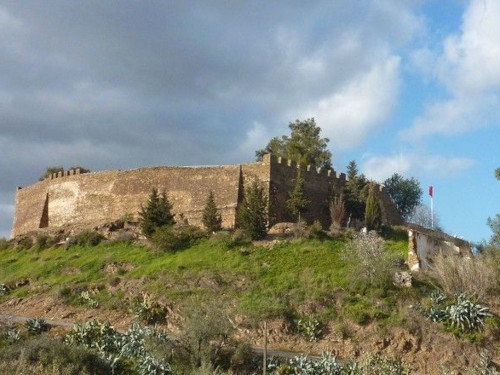
At the time of the Christian Reconquista, the region was conquered by the forces of Sancho II of Portugal (1223-1248) in 1240. Aiming to increase the population and defence of these domains, the sovereign favoured the site of the current town, for whose defence a new castle was erected from scratch, with this work continuing into the second half of the 13th century.
Under the reign of Denis of Portugal (1279-1325), the town received its Charter (1304). The wide belt of walls dates from this period, with three gates: the Guadiana, Tavira and Mértola, arranged according to the corresponding geographical orientation.
The Treaty of Alcoutim was signed within this castle (31 March 1371) between King Ferdinand (1367-1383) and Henry II of Castile, ending the so-called First Fernandine War.
Under the reign of King Ferdinand (1495-1521), the castle was rebuilt and its probable Gothic features were modernized. It was portrayed by Duarte de Armas in his Book of Fortresses (c. 1509) with a quadrangular plan, without dominant towers or towers attached to the vertices of the walls, nor inside the enclosure, with a single door, open in the center of one of the elevations. Its walls are uniformly crenellated, and inside there were some supporting buildings, the foundations of some of which have been revealed by archaeological research. Its mayor at the time (1496-1512) was the Marquis of Vila Real.
The War of Restoration of Independence
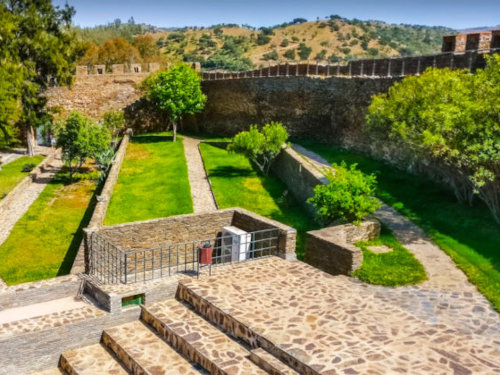
An epigraphic inscription on the Tavira gate indicates that, in the context of the Portuguese War of Restoration of Independence, King Afonso VI (1656-1667) made improvements to its defences, aiming to adapt it to modern artillery fire. In addition to the partial renovation of its walls, a projecting platform was built facing the Spanish border town of Sanlúcar de Guadiana, and the fortification actively participated in the fighting.
In the 18th century, a plan by military engineer José Sande de Vasconcelos reveals the advanced state of ruin of the castle. With no military function, it was abandoned, and later its premises were used as a butcher's shop in 1878.
From the 20th century to the present day
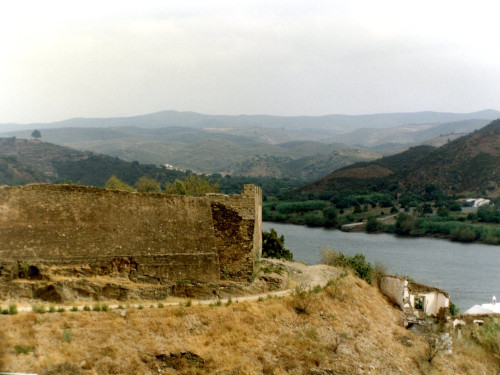
In the 1960s, the monument underwent consolidation and restoration work by the Directorate-General for National Buildings and Monuments (DGEMN), when the walls of some of the buildings that had been adjacent to it over the centuries were cleared and the Battlements were rebuilt.
From 1992 onwards, the City Council carried out a project to revitalise the castle, which resulted in its classification as a Property of Public Interest by Decree of 30 November 1993, and the first archaeological surveys carried out inside the grounds, with the construction of a museum dedicated to the Archaeology of the Municipality, under the responsibility of the architect Fernando Varanda
In 2000, a museum was opened in the centre of Alcoutim Castle, depicting the archaeological heritage of the castle and the surrounding region. Pieces dating from the Neolithic to the Modern Period can be seen there. Still inside the castle, but in a space separate from the main museum, there is a permanent exhibition on Islamic board games from the Moorish period.
Features
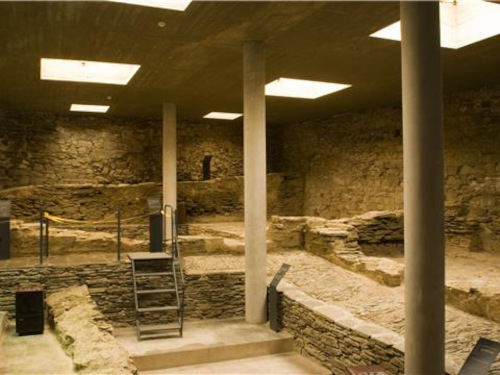
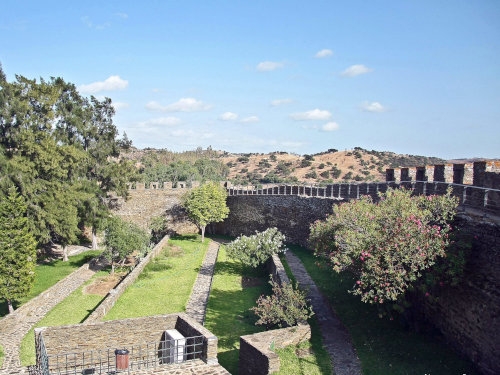
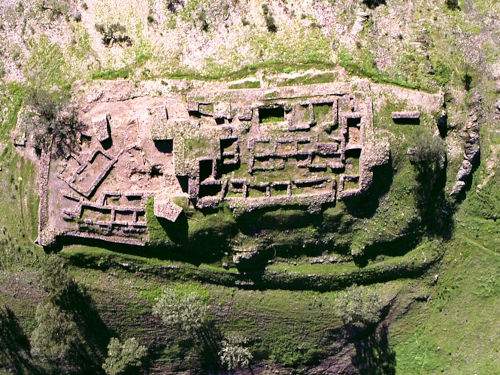
The castle has a rectangular plan, with approximate dimensions of 50 meters long by 40 meters wide, in irregular stonework. Research carried out to date has not been able to determine the historical evolution of its architectural design. Nowadays, only two pointed arch doors, one of which was recently unblocked, evoke the Gothic phase of the monument.
According to the 19th century plan by General José Sande de Vasconcelos, the castle had a double belt of walls: the inner one, with a polygonal plan, reinforced by a circular tower at one of the corners, and the outer one, defending the castle from the waters of the Guadiana River, to the east.
Events of the time
1235 - Marriage of Infante D. Afonso, future King D. Afonso III of Portugal
with D. Matilde II of Bologna.
1238 - Conquest of Mértola by the Kingdom of Portugal.
1244 - March 16 - Over 200 Cathars
are burned at
Montségur,
ending the Albigensian Crusade.
1247 - Abdication of Sancho II of Portugal,
paving the way for the coronation of the Count of Bologna,
future Afonso
III of Portugal, going into exile in Toledo, where he would die.
1249 - Afonso III of Portugal takes Faro, Albufeira, Porches and Silves,
marking the end of the Portuguese reconquest.
1250 - August 15 - Afonso III of Portugal signs in Évora the charter of
the
Village
of Torres Vedras.
- Albert the Great studied the
properties of Arsenic
1253 - Afonso III of Portugal publica a Lei da Almotaçaria, uma medida
que
visa fixar os preços, proibindo a exportação de cereais e metais preciosos.
1255 - Lisboa torna-se capital do Reino de Portugal.
1258 - Carrying out Inquirições,
which when compiled would become one of the most curious monuments of Portuguese medieval
documentation.
1259 - The kings of England recognize the loss of the Duchy of
Normandy
and its annexation to the kingdom of France. Henry
III of England
no longer has the nominal title of Duke of Normandy.
1263 - Agreement of
Afonso III of Portugal with the King of Castile concerning the Algarve.
- Legitimação papal do casamento de Afonso III of Portugal com
D.Beatriz.
1264 -Renunciation of Afonso X of
Castile's rights over the Algarve.
1265 - January 20 - In Westminster, the first English parliament holds its first meeting.
- Czech beer brewed in Ceske Budejovice begins to be called Budweiser.