Background
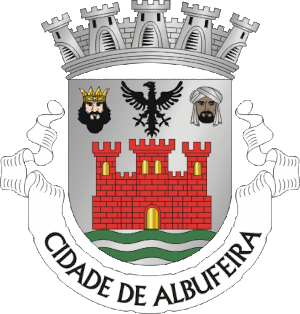
Although there is no reliable information available about the early human occupation of this site, it is believed that this stretch of coastline was already occupied since prehistoric times by populations linked to gathering and fishing. Its port would have led to the formation of a village of some importance, which at the time of the Roman conquest of the Iberian Peninsula was called "Baltum". Its population, alongside fishing activities, would have developed agriculture and trade, bringing economic progress to which the remains of aqueducts, bridges and roads are testimony.
At the time of the Muslim invasion of the Iberian Peninsula, from the 8th century onwards, it would have been fortified, as attested by its Arabic toponym "al-Buhera" meaning "Castle of the Sea". Other authors attribute to the word the meaning of "lagoon", which existed at the time in the lower part, and which would defend the peninsula on which the town stands on the land side.
The Islamic Reservoir was a walled town on top of the rocky escarpment, which corresponds to the current historic center, dominated by a castle. The effectiveness of this defense is attested by the fact that this was one of the nuclei that remained under its control for the longest time.
The medieval castle

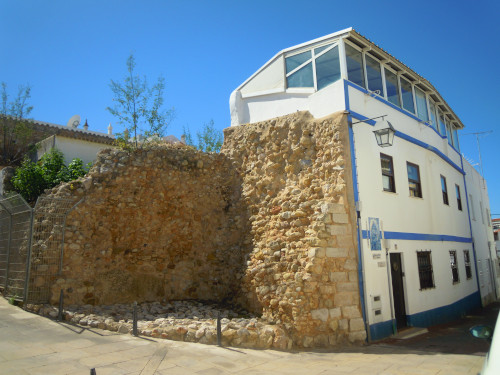
At the time of the Christian À época da Reconquest of the peninsula, after the conquest of Faro, the town of "Al-buhera" was finally conquered in 1250 by the forces of Afonso III of Portugal (1248-1279), with the castle and its domains being donated by the sovereign to the knights of the Military Order of Aviz, in the person of their Master, D.Martinho Fernandes (1 March 1250).
Although there is no information available, it is possible that its defences were rebuilt from then on. It is true that the town developed in the following centuries, since during the time of Manuel I of Portugal (1495-1521), it received a Charter (20 August 1504). Although there is also no information, their defenses must have been reinforced during this period.
From the 18th century to the present day
At the time of the Christian À época da Reconquest of the peninsula, after the conquest of Faro, the town of "Al-buhera" was finally conquered in 1250 by the forces of Afonso III of Portugal (1248-1279), with the castle and its domains being donated by the sovereign to the knights of the Military Order of Aviz, in the person of their Master, D.Martinho Fernandes (1 March 1250).
Since no information is available, it is possible that its defenses were rebuilt from then on. It is true that the town developed in the following centuries, since during the time of Manuel I of Portugal (1495-1521), it received a Charter (20 August 1504). Although there is also no information, their defenses must have been reinforced during this period.
In 1833, at the time of the Portuguese Civil War (1828-1834), the town was surrounded and taken by assault by the forces of José Joaquim de Sousa Reis (the "Remexido"), a captain of Miguelist guerrillas, causing extensive material damage. The fight resulted in around 27 deaths on both sides.
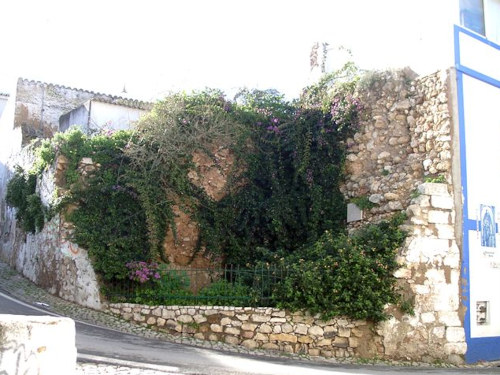
Between the 19th and 20th centuries, the village experienced booms and economic depressions. In modern times, thanks to tourism, a significant surge in progress has taken place. Little remains, however, of the town's old medieval walls, which did not resist urban progress and were demolished in the 1960s when the "Hotel Sol e Mar" was built. These remains are not listed or in the process of being listed by the Brazilian government.
Features
The medieval castle had a quadrangular plan, with a tower at each vertex. This fortified perimeter would correspond to the Muslim citadel. The village was accessed through three gates:
- the so-called "Porta da Praça" or "Porta do Oeste", which was the main gate, at the height of the current Praça da República;
- the "Porta do Mar" or "Porta da Praia", to the North, where a section of this wall remains, on the current Rua Joaquim Pedro Samora; and
- the "Porta de Sant'Ana", so called because it gives access to the Chapel of Sant'Ana (disappeared in the 1755 earthquake), located a little further down, on the right side of the current Fiscal Guard Post. In the 18th century, the cult of Saint Anne began to be celebrated in another temple, under the same invocation.
The so-called Clock Tower, which is currently part of the building of the Santa Casa de Misericórdia, on Bernardino de Sousa Street, was originally one of the Muslim towers that defended the Porta da Praça, where the old prison once stood. It stands on the castle wall next to the old gate to the Plaza de Armas. In the 19th century it was fitted with an iron crown that supports the hour bell.
Events of the time
1258 - Carrying out Inquirições,
which when compiled would become one of the most curious monuments of Portuguese medieval
documentation.
1259 - The kings of England recognize the loss of the Duchy of
Normandy
and its annexation to the kingdom of France. Henry
III of England
no longer has the nominal title of Duke of Normandy.
1263 - Agreement of
Afonso III of Portugal with the King of Castile concerning the Algarve.
- Legitimação papal do casamento de Afonso III of Portugal com
D.Beatriz.
1264 -Renunciation of Afonso X of
Castile's rights over the Algarve.
1265 - January 20 - In Westminster, the first English parliament holds its first meeting.
- Czech beer brewed in Ceske Budejovice begins to be called Budweiser.
1267 - Signing of the Treaty of Badajoz, which establishes the borders
between Portugal and Castile.
1270 - End of the Eighth crusade.
1279 - D. Dinis becomes king of Portugal.
- The first references to the Azores archipelago originate from sea
voyages made by Europeans in the 14th century,
namely from Portugal during the reigns of D. Dinis (1279-1325) and his successor,
Afonso IV.
1281 - Beginning of the armed struggle between D.
Dinis and the
infante D. Afonso, his brother.
- D. Dinis offered the town of Monforte to his daughter
D. Isabel as a dowry at
her wedding.
1282 - June 26 - Wedding, in Trancoso, of D. Dinis, King of Portugal and
Isabel of Aragon.
- Agreement between D. Dinis and his brother Afonso, in Badajoz.
Afonso promises to destroy the walls he had built, be knighted and become his vassal.