Background
Although older authors believe that the earliest human occupation of the site dates back to a prehistoric hillfort, recent archaeological research has confirmed that it occurred in several phases from the Chalcolithic period to the Roman occupation, although not necessarily in military terms.
Archaeology has confirmed that, before the Middle Ages built a castle here, there were several phases of settlement, identifying materials from the Chalcolithic (in particular bronze axe casting moulds), protohistoric and Roman periods (the latter corresponding to ceramic elements apparently associated with a 4th century rubbish dump and not with an effective military presence)
The medieval castle

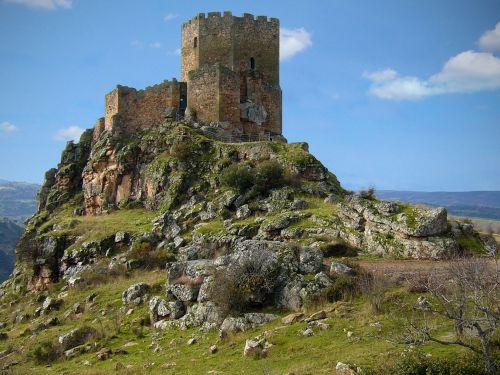
At the time of the Christian À época da Reconquest of the Iberian Peninsula, the original boundary line of the county of Portucale with the kingdom of León ran along the left bank of the Sabor River up to its confluence with the Angueira River. This border was guarded by four main sentinels: the Castle of Milhão, the Castle of Santulhão (both now gone), the Castle of Outeiro de Miranda (in ruins) and this Castle of Algoso. Complementing this main defense of the northeastern sector of Trás-os-Montes were the castles of Penas Roias, Mogadouro and, although further away, Bragança.
The most recent studies indicate that the construction of the primitive structure of the castle dates back to some time at the end of the reign of Afonso I of Portugal (1112-1185), when his son Sancho already exercised royal power. As recorded in the Inquiries of 1258, it was built by a local lord, Mendo Bofino (or Mendo Rufino), who in return received the lordship of the town of Vimioso.
From 1224 onwards its structure was radically altered, at which time the castle was donated by D. Sancho II (1223-1248) to the Order of the Hospitallers (known, from the 16th century onwards, as the Order of Malta), after a relatively long period of war with the kingdom of León. At the time, this castle was the highest exponent of local power, the residence of the royal representative in charge of collecting royal duties in the lands of Miranda and Penas Roias.
The ancient town and municipality of Ylgoso, Ulgoso or São Sebastião de Algoso, was part of the bishopric and district of Bragança. In the year 1230, the Order of the Temple and that of Saint John of the Hospital made a concordat in Coimbra over several disputed lands, including Ylgoso (Algoso), Vila Chã, Atenor, Penas Roias, Paradela and others, outside the bishopric of Bragança.
On June 22, 1239, D.Pedro Costem, commander of the Order of the Temple in Portugal, made a composition between the commanderies of Mogadouro and Penas Roias, belonging to his order, and that of Algoso.
Later, on February 13, 1291, D.Dinis (1279-1325) made a new agreement, in Coimbra, with the Grand Commander of São João do Hospital, D.Fernão Peres (Mossejo), regarding the commandery of Algoso and other nearby lands. Its importance came from the income earned annually by its commander: from seven to eight thousand cruzados, including in this amount two parts of the fruits of the abbeys of Travanca, Sendim, Vilar Seco, Duas Igrejas and Guide. This sovereign would also have ordered the carrying out of repair and improvement works in the castle.
In possession of the Hospitallers, the castle was transformed into a Gothic-style fortification, highlighting the construction of the solid keep, which served as the commander's residence, and a Turret on the wall to the south.
In 1480 Algoso received a charter from Afonso V of Portugal (1438-1481), confirmed by Manuel I of Portugal (1495-1521) on June 1, 1510 (New Charter). During this period, the town and its castle are depicted by Duarte de Armas (Book of Fortresses, c. 1509). The 1530 Numbering states that only the mayor lived in the castle.
From the 16th to the 18th century
During the succession crisis of 1580, Diogo Fernandes de Almeida, father of Friar Gonçalo de Azevedo, knight of the Order of the Hospitallers, commander and mayor of Algoso Castle (1588-1610), sided with the prior of Crato. During the Philippine Dynasty, King Philip I granted a charter of privileges to the Algoso City Council (January 1, 1592).
By 1684, it was among the many abandoned and ruined structures in the kingdom. During the Seven Years' War, shortly after the fall of Miranda do Douro in 1762, the Spanish launched several raids to plunder the lands of Vimioso. Garrisoned by a small force, under the command of an ensign, the town of Algoso managed to resist without being occupied.
Later, the military government of the town was exercised by a captain-major, a sergeant-major and four captains of Ordinances.
From the 19th century to the present day
During the Peninsular War, the judge of Algoso, Jacinto de Oliveira Castelo Branco, refused to recognize French sovereignty and, even after the departure of the Royal Family to Brazil, with the French declaring the Braganza dynasty abolished, he continued to use the name of His Royal Highness in the processes under his responsibility.
In the mid-19th century, the municipality of Algoso was extinguished, becoming part of the municipality of (1855).
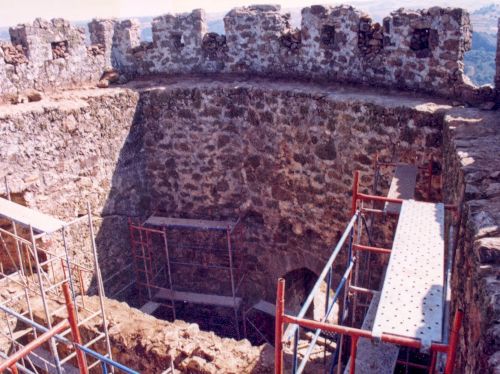
In the 20th century, from 1944 onwards, the castle received minor improvement works by the Directorate-General for National Buildings and Monuments (DGEMN), being classified as a Property of Public Interest by Decree No. 40,361 of October 20, 1955. Subsequently, between 1974 and 1977, the castle was promoted conservation work on the walls and access walls, as well as the consolidation of the steps leading to the monument's gate.
Recently, in 2004, new stages of intervention took place, under the responsibility of IGESPAR in partnership with the Vimioso local authority, reinforcing the importance of the castle in the region's tourist circuit.
Features
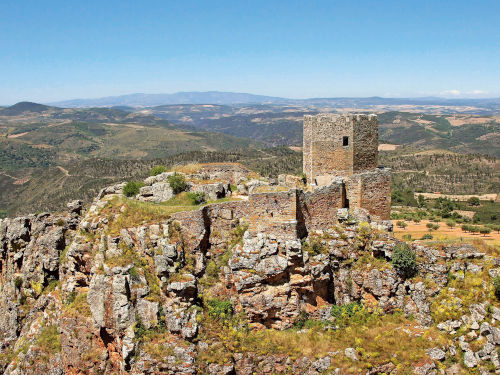
Small in size, it has an organic plant (adapted to the terrain), with a rectangular shape. It was built in quartz schist and granite masonry, on a rocky outcrop, at an elevation of 681 meters above sea level.
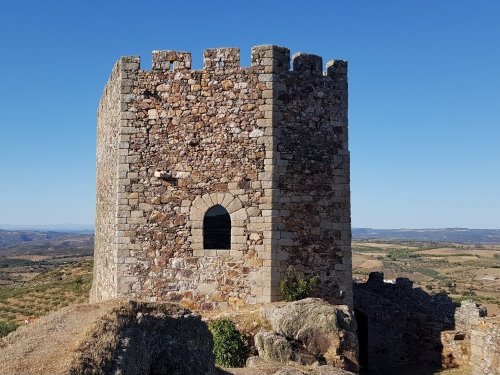
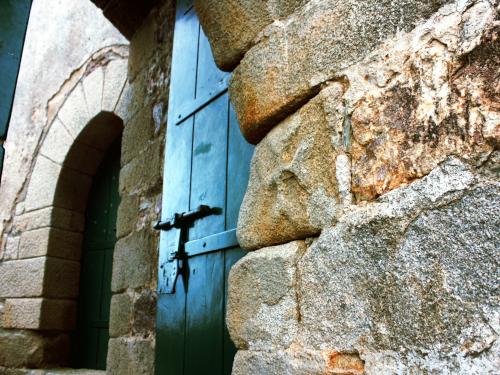
In the wall, to the north, there is a full-arch entrance gate, accessed by a staircase with steps carved into the rock. This gate is defended by a small Turret, now without its Battlements, where a balcony with boulders stood out. Passing through the gate, a small parade ground opens up, from where, in turn, you can access the keep. It has a heptagonal plan, divided internally into three floors. The first two were intended for housing and the last for defense.
In a tower, on the eastern face of the walls, spaces were opened for artillery pieces.
Events of the time
1112 - Afonso
Henriques inherits the County of
Portugal from his father, but his mother, Theresa
of León, who governs as regent.
1113 - Restoration of the diocese of Porto and episcopal consecration of
the archdeacon Hugo,
bishop of Porto, faithful cleric of the archbishop Diego Gelmírez.
1116 - April - The Bishop of Porto obtains from the papal curia
the placement of the diocese of Lamego under his administration.
1117 - An almorávida invasion
seriously threatened Coimbra and its domains.
The Moors forced the inhabitants of the Castle of Soure, which defended the city from the south,
to abandon the place,
and took Miranda do Corvo and the Castle of Santa Eulália, downstream from
Montemor-o-Velho.
- D. Teresa begins to use the title "queen" in documents.
1118 - Foundation of the Order of the
Templars
1119 - The Pope definitively assigns the dioceses of Coimbra and
Viseu
to Braga.
1122 - Afonso I of Portugal,
still an infant, becomes a knight in the Cathedral of Samora.
- Marriage of Urraca Henriques, daughter of Count D.
Henrique
and D. Teresa,
with Bermudo
Peres de Trava, member of the powerful noble Trava family of Galicia.
- The Astorga Charter was written.
1123 - Viseu - counts D. Teresa and D. Henrique who, in 1123,
granted it a charter.
1126 - Alfonso VII of Castile becomes Emperor of Castile and Kingdom of
León, after the death of
his mother D. Urraca.
- Afonso I of Portugal tries, in vain,
to take Alcácer do Sal.
1153 - Foundation of the Cistercian abbey of
Alcobaça.
S
1158 - The Pound Sterling becomes the currency of England.
- June 24 - Conquest of Alcácer do Sal.
- May 22 - In Sahagún,
Fernando II
of
León and Sancho III of Castile
agree
to join their efforts to subdue Afonso I of Portugal.
1159 - Donation of the Wax Castle to Gualdim Pais.
- December 22 - Afonso I of Portugal meets in the town of Santa
Maria de Palo with King Fernando II of León, to
resolve the issue of border demarcations of the Portuguese and Leonine reconquests.
1179 - The Pope recognizes Portugal as a kingdom.
- May 23 - Bull "Manifestis
Probatum",
by Alexandre III,
confirming the
possession of
the Kingdom of
Portugal
to D. Afonso Henriques and his successors.
- D.
Afonso Henriques and his son Sancho, future Sancho I of Portugal, grant charters to
Santarém, Coimbra and Lisbon.
1183 - Creation of the Inquisition through
the Council of
Verona.
1185 - Sancho I succeeds Afonso I of Portugal as king of Portugal.
- Construction of the Cathedral of
Évora.